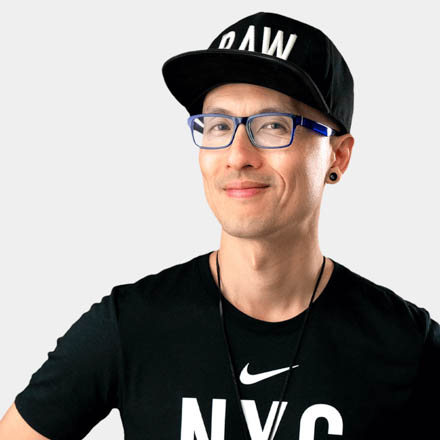
Uh about a week ago, I was asked to speak on a topic and I've put together a brand new presentation for some of you. So bear with me if there are some typos and some weird things. And the reason why I did this is because they asked me to talk about the topic of virality. And nobody does a better job than that than Brendan Kaine. He's our friend. Uh we he's been on multiple podcasts with us. So Brendan, with all apologies, I'm going to take a little different approach and talk to you about something because when I think of Mind Valley, I think of a more spiritual personal uh pursuit versus this thing. There's this promise of social media that anyone can go viral. And I wonder why or where we got this idea from that anyone can go viral, right? And I think it's the social media networks have told us this and they make this promise like they dangle that little carrot for us to pursue and it keeps us chasing. So I want to ask you this question. If anyone can go viral. The question is should you? So I want you to think about this. Okay. Some of you may know this person. His name is Mark Manson. Do you know Mark Manson? Anybody? Okay, great. Well read group here. I love that. He wrote this book called The Subtle Art of Not Giving an F. And I heard him say this thing about if you want to be a 1enter, and I don't think he's talking about the top 1% of the richest people in the world, but the people who make the greatest impact in the world, the top 1enter, they have something in common. They all do this one thing. They are contrarians. When everyone's going one direction, they go the opposite direction. But any fool can go a different direction. So you have to be a correct contrarian. You have to find something that goes against what the mainstream is saying, whatever it is that you strongly believe in your heart. Not to do it because it's it's a gimmick, but because you believe in your heart, this isn't correct. Because if you say what everyone else is saying, you're going to disappear in all the noise. So, you have to become a correct contrarian. And I take this very personally because I am not trying to be contrarian, but I have very strong points of view on lots of things. So, I'm going to use this opportunity to probably undo everything that Brendan just said. Okay. So, we're gonna have a little bit of fun together. Okay. So, from the people who are laughing, I presume you were here for that. And for the people who are not laughing, maybe you're going to be mad at me or you're just new here. So, it's okay. This presentation exists with or without Brendan. He's a very important person. So, I want to ask you this question, okay, to reflect on this idea a little bit, which is in an era of fast fashion, what is the consequence of fast fashion? You know, certain brands that make things really quickly, they not only destroy legitimate fashion brands by knocking off their designs, but they're producing things that are such a rapid pace that they are the most harmful companies to the environment, even more than big oil. It's a shocking idea. So if we like fast fashion, we have to come to the consequence and understand what happens to all the clothes that we don't buy because it's become cheaper to replace the clothes than it is to wash the clothes. That's scary to me. And then in the era of fast food, what's the consequence of fast food? We have a lot of engineered things that last a really long time. Good for shelf life, not good for your body. And I don't know about you, I prefer things that are less processed over things that are processed in an era of easy money. What could be the problem with easy money? What could be the problem? Well, you know, get rich quick, you also lose it really quick. Easy come, easy go. Very high percentage of people who win the lottery wind up right back where they started. I wonder why. Because maybe, just maybe, there is something to the pursuit of learning something, working hard that is more desirable than the result itself. So, I hope you start to hear a theme here, and I'm going to build my argument. And then we think about things like a crash diet. Anybody here been on a crash diet? New Year's resolution to lose a lot of weight. The problem with crash diets there, the the hint is in the title itself crash. Maybe the word die. So, you're on this yo-yo diet, right? When you may start off large and get to medium small, but because this is not a lifelong pursuit because you see it as a very short-term goal to hit, maybe once you hit the goal, you regress because those habits haven't been formed inside of you. Kind of an important thing to think about. Okay? And then, I'm this is not a real term. Does anybody here want fast fans? Okay. Okay. I didn't think so. You don't have to agree with me. We can have an argument. This can be very interactive. So, people of convenience maybe. So, what's the problem with fast fans? Well, I don't know about you. This is a generated image, but it's a symbol for the things that are going on with engagement farms. You pay, you get the views. As soon as you stop paying, you don't get the views. You don't get the fake engagement. And I would rather have a hundred people who are dedicated who truly want to consume my content than a million people who are there because somebody's clicking it in some country. So that's that's it with that. So what I would like for you to maybe kind of rethink this idea of v virality. We came out of a pandemic. I don't know about you, but I'm not so keen on viruses myself. So the antidote probably to this idea of going viral is to be antiviral. So my talk is called the dark side of virality. Why success or easy success might become a prison sentence for many of you. Okay. So I'm going to ask this question and I do a style of talks where I'd like to interact with you as much as you're comfortable doing and I understand different cultures people like to talk some people don't. I will work with whatever you give me. Okay. So what is the goal of content creation? I just want you to reflect on this. So, if you're watching this on Zoom, just type it in. What is the goal of you creating content? I'm going to give you a second because maybe there's a delay. Then I'm going to ask the audience here, what's the goal of you create? How many people here are creating content? You make a post, a podcast, a carousel, uh a YouTube video, Instagram reel. So, almost everybody here, I'm glad to hear that at least the programming is right because this is the social media summit of the 1 billion followers summit. So, if you're here, maybe you're curious or you're actually doing something. So just randomly yell out just like a little bit at a time, not all at once cuz then I can't process that. What's the goal of you creating content
>> right here? What's that
>> connection?
>> Oh yeah, hold on. Hold on everybody. Oh my god, I know where we are now. This is like uh bizarre. We're trading things. Yes. I just need to understand the word. I can manage
>> uh sales.
>> Sales to sell things. You make content to sell things. Okay, great.
>> Educate.
>> Educating. Are you an educator?
>> Yeah.
>> Okay, that's why. Okay. Over here.
>> Awareness.
>> Awareness. To build awareness so you can get sales or to educate?
>> Educate.
>> Okay. So, education. Okay. Yes.
>> Entertain.
>> Entertain. Do you tell jokes? Are you a funny guy?
>> Uh, yeah. I I do funny vlogs and stuff.
>> Okay. Maybe not right now, but Okay. Over here.
>> Making money.
>> Making money.
>> Oh, we got to make some money, huh? Okay. Last one.
>> What?
>> Fashion.
>> Fashion.
>> No. Fashion. Fashion. Passion.
>> Passion. I love that. What's your passion friend?
>> Uh, history.
>> Oh, so education.
>> No.
>> Yeah. Yeah. Yeah. It's okay. Okay. You know. Okay. One more. You're She's like, "Pick me or I'm going to be mad at you. You're going to get an angry view for me." Yes.
>> You want to create clones of yourself?
>> Online. And then share your knowledge.
>> Okay. It might be a language translation thing. I'm ESL too, so maybe there's another word. I think what you're saying is you can make a positive impact in the world and inspire people to do the things that you want to inspire them to do. That's what So you're talking about thought leadership through education. Yes. Beautiful. Okay. Thank you for participating. Okay. So I I took the guess that maybe some of you want to do awareness, build awareness either to promote and to create sales or awareness around an idea, eat less of this, eat more of that, uh be kinder, you know, those kinds of things or or meditate more, whatever the idea is. Some of you want conversion to create content to get more sales, right? And some of you, nobody said this, but does anybody create content to build trust? Yeah. Okay. There's an asterisk on that because we're going to come back to that in a little bit. Okay. I just realized I'm going too slow. I need to speed up. Okay. 10 minutes have been lost. Okay. When we do awareness, it's not just called content creation. It's called marketing. You understand that? Yes. So what I don't like is when we use one term to describe too many things then the words lose meaning and we have to be specific about the words that we use because the words shape our worlds. Yes. Okay. When we do conversion what is that called then?
>> It's called sales. Very smart audience. So what I don't want to do is mix all this stuff up. But when we build trust what do we call that?
>> Branding. Yes. Good job guys. Great job. Look at this. We agree. So far so good. Okay. So your goals. So, if we're going to create content, what's the goal of creating content? Well, let's let's play along. Let's say we really want to go viral. Does anybody here want to go viral? Raise your hands.
>> Yes. Some of you are like less excited about raising your hand now because you're like, "It's a trap. It's a trap. Don't do it." But let's be honest with each other. We can do that. So, let's say your goal is to be viral. Okay. So, what are the two options of going viral? Uh, as far as I can tell, yes or no. Okay. So, what happens if we actually get our wish of going viral? Here's what happens. Awesome. We get great reach. We get more engagement. We get more follows. Hallelujah. Maybe we make some money through monetization. We're really excited about making more content cuz shoot, we're rewarded for it, right? That's how the algorithms sink their hooks into you, by the way. And I went viral. You can just wackle with a little bit more confidence. Yes. Not like that, but you know what I mean. Okay. So, what happens now? Well, we we get into this loop. We went viral. We need to go viral again. There's a little problem here. Then we enter into this trap. It's called the validation loop where we're looking outside to be validated versus looking inwards to be validated, right? Exttrinsic versus intrinsic. That's the problem. So, even at your best possible outcome, you get what you want, but now you're stuck. You want it again and again. I'm going to go deeper into this in a second. So the question for you is, is it sustainable? Now, we need to have a common definition. What does it mean to go viral? It means that you have an outlier. Something that is 10x what you normally produce. You get 100 views, you get a,000 views. That's viral. If you do a,000 views, you get um what is it? 10,000 views. That's viral. So maybe my math is just bad, right? So 10x. How many people here have made a piece of content that's gone viral for them? Raise your hands. Okay, those of you keep your hands up. Keep your hands up. Air out the armpits. Some of you are sweating. Okay, you've gone viral. How many were able to repeat it? Lower your hand if you can't repeat it. And how many have been able to sustain it over and over and over again? Lower your hands now. Only a handful of people. The person in the front, of course, she's must be really smart and very good at making content. Beautiful. Okay. So, let's take the other path now. Okay. What happens when you don't go viral? This is the dark side that nobody is really paying attention to, which is now I'm not really motivated to make content anymore. And my ego, my self-esteem, my self-worth, my self- value takes a hit. And sometimes it leads to depression. And if you do this for long enough, it leads to burnout. Has anybody ever felt burnout on creating content? I mean, everybody's hand should be up right now. Let's tell the truth, people, please. Okay? And then what happens is eventually burnout leads to you quitting. So I presented to you a very structured argument why neither option is good. Yes, maybe we can argue later. So the problem with virality is it's based on an outcome. Do I get to go viral or not? And we have to ask this question. Is there something beneath the surface that's a bigger problem? So I'm going to present to you four really quick problems and we'll go through this. Okay. Number one is the seduction. Okay. Virality feels a lot of times very opaque. None of the platforms tell you how to go viral. So there's all these professional gurus, coaches, and programs that you can enter telling you what they guess what it is even though the platforms do not tell you. It's a very opaque process. And I think what they give they can take away. And I personally do not like to export my emotional well-being to a machine to the corporate overlords. Okay? Maybe you you like it, I don't like it. So I talked about this before. So what we used to look inside for whether or not we're doing the right thing, now we're trusting a machine that we do not understand from our corporate overlords who never talk to us to regulate our emotional well-being. I don't like this at all. And I'm going to share a little story with you. There's my friend, her name is Jodie Cook, and I've talked about her in a couple different ways. Jodie Cook on Instagram has 155 posts and 10.7,000 followers. Her typical content is 2,000 2,000. And wait a minute, there's a viral post right there. It has 2.9 million uh views and then it goes back to 4,229. Okay, now my friend Jodie Cook, who I featured on my channel, so it's a collab reel, has all this attention. She goes, "Chris, I've never gone viral before. Is this what it feels like for you and your life?" I'm like, "No, I don't go viral either. I don't know what's going on." Okay, so let's take a look here. That's the clip. All right, look at the engagement. So they're like, "Finally, I made it. I made it. So, Jod is um she writes for Forbes as a senior contributor. The impact of this one post going viral inspired her or maybe demanded of her to write an article and she wrote, "What really happens when you go viral on Instagram?" So, number one is your notifications are blowing up and she's trying to not pay attention to the phone, but it's going off all the time. She can't focus on anything else. She's constantly checking her phone to the point in which she has to turn it off and turn off everything. And now because she wants to keep checking the new numbers and the messages that are coming because it's so addictive, she came and do basic tasks and her inbox is crazy. It's flooded with messages. But there's this other part which maybe some of you have experienced. Threats, harassment, name calling, and bullying are coming in. Yeah. Anybody have experienced that before? The trolls. Yes. not nice and if you're not built for it, if you haven't earned it over time, it can be overwhelming. So, I'm just going to read some of the more sanitized comments that were left on this post. Okay, number one, uh I can't read this. All right, it says, "When all you are is money, how poor your life must be." This is a complete stranger. And there's a reason why they say this when you go viral, because they don't know you. They just see this thing and they judge you for everything based on one thing you said or the way that you look or how long your skirt is or if you wear a baseball cap when you talk or not. Okay, here's another one. Uggh. These guru prices are out of control. The coaching space needs serious regulation in place. This person, I guarantee you, has done zero research on looking into her programs and how she coaches. You feeling it? Have you had comments like this before?
>> No. I love the fact that you're putting them out there. Is that wrong?
>> You know what? You know what bullies don't like is being bullied themselves.
>> How you like them apples. You know, I could tell you stories, but I'm not going to today
>> unless there's time. What's that?
>> Tell them.
>> I love my bullies. I love the trolls. I'll tell you later. Love the enemy. It's the best approach. I make more content from the bullies than I do of the lovers and the fans. I'll tell you why. Because there's a friction point. The internet loves friction. So, I have an opportunity to clarify what I meant to say or how you might have misinterpreted this. It even usually it outperforms original posts. Okay, here's the last one. One word, escort. Yeah, I told you I'm giving you the more sanitized version. You guys know what escort means, right? Yes. Okay. I don't know. We're in Dubai. I don't know what we can talk about here. I'll probably have canceled. I will never be here again. Okay. Number two, the addiction. the addiction happens. You chase the dragon. Do you know the term chase the dragon? Okay, probably not here, but anyways, there's this flood of uh happiness, dopamine, and then dopamine leads to depression. Okay, and I think this whole thing is very close to a different kind of relationship, a perilous dealer addict relationship. You're the addict, you're not the dealer. I promise you. Okay. So, what do dealers do? They hook you with a sample, a viral moment. You feel the high and when you don't have anymore, you experience withdrawals. You don't know what to do with yourself and then you're constantly checking the stats. It's like you scratching like, "Oh, I need another fix." And now you have to chase your next fix. This is what's happening, right? So, the weird thing is the day before your post went viral, you were really happy with yourself, weren't you? You're making progress. I'm communicating. I'm becoming a better communicator. I feel better about myself. So what used to make you happy doesn't make you happy anymore. Weird because once you experience this feeling, everything else sucks in comparison. So you're chasing this thing one more time. So now you start to go in this negative spiral, this vicious cycle where you have more bad moments than good moments. Who still wants to go viral? Let's just keep checking the room. Okay, cool. I like that. You are resilient.
>> No, I have a point. It's not a
>> Well, wait. Can I finish the presentation before you make your point? There will be a point when you can make that point, but not right now cuz I'm worried about my time. Okay, cool. We're about halfway through. Okay, number three, the prison. Okay, what happens is when you go viral, well, what do you do? You try to repeat that. You might have been an experiment. You might have done something really goofy. You might have like put ice on your face or something. Now, every video you got to throw ice on your face. So, you become a caricature of yourself and you no longer feel like it's you who's showing up. So, you become a slave to the algorithm. This is why it's a prison. Brendan, hate me later, but I'm I'm gonna keep moving on. There's this idea. It's called the authenticity gap. Okay? It's the space that exists between the real you, who you are in private to your very best, most trusted friends, and how you show up in the world. Like, I don't sit in the hotel room with my skirt on. It's too uncomfortable. This is how I show up here. So, I am in some way operating as a persona or a character of myself. I'm wearing a hat. I have a mic. These aren't normal things I would do if I was sitting there in the living room watching TV. There's no need for that. So the bigger the gap between the real you and the persona who you show up to be in this world determines the lack of authenticity. So what's happening when you go viral? You show up even less of yourself. You become a prisoner of your own stupid success because this is all that people want from you now. So you have to maintain this image that you've created because you are so in love with this idea of attention and sooner than later you start wearing this mask and you can't even see yourself anymore. Your interests, your values and your personal growth take a backseat to keeping the relationship between you and the dealer happy and stable. It doesn't sound so good anymore, I don't think. And every time you try something different, you want to return back to the real you. You get punished for it, don't you? Oh my gosh, I'm shadowbanned now. What happened? Oh, you have fake followers cuz how did you get all that growth and now no one cares? Because you did something that they don't want to see from you. They'll leave comments like this. This isn't what we followed you for. Okay. So this avatar, this thing that you created to go viral becomes your prison. Okay. Number four, the awakening. What you start to realize is being viral doesn't mean you've done anything valuable. I'm sure you've scrolled through the feeds on Instagram, on Tik Tok. I think they call it brain rot for a reason. It's not necessarily valuable. It's just what the algorithm wants. And the algorithm, depending on the platform, rewards you every 10th post to give you an artificial boost. They give you a little love bomb. We love that you're on your 10th post. So, we're going to juice the numbers for you because they are like drug dealers. They want to keep encouraging you enough so you don't quit because the the platforms win when more people create. And you you start to understand that bigger reach doesn't mean that your message resonates anymore and that followers doesn't equal community. And I will go into that. Okay. Now, if you are here like many of us, you're trying to develop your personal brand, right? You guys are trying to develop your personal brand. What you need to understand what branding is. It's the stickiness of the relationship. It's how loyal people are to you. And there's simple tests. All you have to do is ask them to do something simple. Comment this. Go vote for me. Like, I'm I'm up for an award. Please vote for me. Please nominate me as a speaker for this event. or who knows an organizer who can put me in touch with somebody who will do the introductions. So, you can test the strength of those relationships in the community just to see how sticky it is. Okay, now here's the story. I'm sure some of you know this. VidCon is a big conference for YouTubers to create content. Post pandemic, they open it back up in 2022. Tik Tok is blowing up like crazy. It's sweeping all over social media. There's a good chance that if you're on Tik Tok, it's because it was in 2022 that everybody was telling you you must be on Tik Tok. Yes. Okay. So, what did VidCon do? They invited some of the biggest Tik Tockers with millions of followers to come and speak. I was at that conference. And this is an illustration of what those rooms looked like. Massive rooms for 500 to 800 people. Even for some of the biggest creators that you know and love, about 20 to 30 seats. Not percentage, 20 to 30 seats. fewer people than the people in this room for a room six times as big as this room. So, there was a Business Insider article in July of 2022. Why Tik Tockers may face problems forming deep connections with fans despite the platform's hold on Gen Z. And there's a woman, her name is Grace Africa. She has 1.3 million followers on Tik Tok. She she said, "When you set up a meet and greet and no one comes, how heartbreaking is that? this relationship that you thought you were building wasn't a relationship at all because you're chasing a number. So, here's what I conclude. Short-term fame doesn't build lasting bonds. Again, I'd rather have an army of 100 like Leonitis have my back than 10,000 people who never show up to help me fight. Okay. So, we're going to move into the light a little bit because you're like, "This is super depressing, bro." You're like, I want my money back. If you if I charge you, I'll give it back to you. But I haven't. So there we go. Deliberation. Okay. So what we need to do is to move away from the metrics to what really matters to us. And how you answer this question is super individual to what your real goals are. Okay. Now if we if you need clients and all of us do need clients to the degree. If you need sales, you need revenue because you are able to sustain a business, that's fantastic. Invest in marketing. Invest in a sales program. Invest in sales training. But this is not why we make content in my opinion. In my humble opinion. Okay. So what matters to you? Let's use this same decision flowchart again and say, well, what's the goal of creating content? Now does somebody have a new answer for me besides going viral?
>> Create raving fans. Okay.
>> And having fun.
>> Having fun. Okay. Here's the cool thing. Creating raving fans is not the goal. It's a byproduct of a goal. Having fun may or may not be the goal, but it could also be a byproduct of the goal. Okay. Now, I heard my friend Blair N share this on stage. I'm going to screw up the story. They had like a hundred entrepreneurs very successful in a room. They asked every single one, write down on a post-it note, what's important to you? And out of a hundred different entrepreneurs from all over different spectrums of success in different industries, they almost all wrote the same answer. Do you know what that answer is? Okay, check this out. They want to grow personally while helping other people. Amazing. You're like surprised. Look at his eyes just got three times bigger on me. It's like, close your eyes, bro. You're blinding me right now. I'm just kidding. Okay, so maybe the goal in creating content should be personal development to better ourselves while helping other people. That to me is worth more than going by row. Okay, so let's look at the same decision. What happens if you work on personal development and it works out well? What are the rewards? Well, you feel like you grew. You develop new skills. You become a communicator. You build the the ability to like rhetoric, like the ability to persuade people with the spoken word. You find a lot more about yourself. Your identity gets more defined. I found my voice in this world. And because I know who I am, I'm more confident and I care less about what people say about me. That's a pretty good one. Pretty good. So, if you repeat that, that's awesome. It's excellent. What happens if you don't achieve that? You learn because in life, you either win or you learn. So, it didn't work. Cool. It's an opportunity to learn. And if you keep paying attention to the lessons, you will eventually get there. I think that's more worthwhile. The flip. Okay. Uh this goes directly against what Brenda just said, so let's do it. Right. Uh, quality versus quantity. He goes quality matters, right? Didn't he say something like that? Chris gonna say something whatever. All right. I know that's not how he sounded. He's more monotone than that. Okay, we're friends, guys. We're friends. At least up until today. Okay. Are you familiar with this book, Art and Fear? Observations on the perils of art making. Okay. It's written by David Bales and Ted Orland. Okay. And there's an art experiment and it's been changed a little bit, but they they gave a an assignment to pottery students. And group one, they divided class in half. Group one, they said, "Hey, here's your only criteria. You're graded on how many pots you produce." And group two, the other half of the room, they said, "Hey, you're graded on one single piece. Go make a masterpiece." Okay? If you don't know the story, some of this might surprise you. Okay? So, let me just reiterate. Group A purely measured on how many pounds of pottery you make. Group B, just one. We're going to grade it to see how great it is. Here's the surprising result to all of this stuff. Okay. Now, you would think the ones had all this time to craft the most beautiful pot. And if you're a creative PE person, you always say, "If the client gave me more time, it would be better." That's a lie you tell yourself every single day. Okay? Because creativity expands or contracts to meet a deadline. That's how creativity works. Everything else is a lie or an excuse. Okay? So it turns out many of the students who were asked just to do one piece did not even complete one piece. Why? They were trapped by making the perfect thing because no such thing as a perfect thing. The better work consistently came from the other group who didn't even have the criteria of making perfect because there's a reason why because quality leads to quality. So we've been getting this wrong. I'm a designer classically trained. This is what they emphasize every single day into our brain. But luckily, I don't listen so good. Quality, quality, quality. No, I'm going to put in my reps. And I'll tell you why. Uh, this is a Tony Robbins quote. Repetition is the mother of skill. You got to do it over and over and over again. Because you are what you repeatedly do. Yes, that's why how you do one thing is how you do everything. Okay, just think about that. And then I added to this skill is the foundation of confidence. And would you like to be more confident? I would. Okay. It's the wish I would have for all of you is to be more confident in yourselves, in your decision-making, and who you show up to be online. Uh, one of my favorite people in the world, Jim Ran, said, "What you become in the pursuit of your goals is more important than the accomplishment itself." Do you understand that? What you become in the pursuit of virality or content creation is how who you become. So, goals are great. What's more important is the development that happens within you because no matter what happens at the end, no one can take this away from you. I think that's why we're at conferences like this. So we can learn something so we can take away having been transformed to live richer lives. Okay? It's the pursuit and not the goal itself. So I want to talk to you a little bit about alignment. Okay? Many years ago I'm in Las Vegas at a conference, a technology conference, and I'm meeting up with a former student of mine. He's an entrepreneur. He's doing really well. We're meeting up at some Las Vegas hotel bar. We're sitting down and having a meal. And he says to me before the waiter comes out and takes our order. He goes "Chris I noticed something about you. You seem really happy. Like you're almost glowing right now." I'm like, "I am?" He said, "What's going on? We haven't seen each other in a couple of years." Former student of mine. I said, "You know what, Greg? I think I've figured out the secret to my life." And I take out a little napkin. I said, "You have a pen? Give me something here." It's the cliche napkin drawing, right? And I drew something like this. Not this. This is AI. Okay. I drew three circles. I think I finally figured out my life in my 40s. Something that I love to do, something I'm really good at, and what the world needs. Cuz right around here in about 20145, a former classmate of mine invited me to make content on YouTube. You're thinking, YouTube was that moment, that inflection point in your life? That sounds super shallow. Well, I'll tell you why. Because for 15 years, I taught at Art Center. It filled my soul with joy. It recharged me all the way. But the problem was when I was teaching at school, they paid me $58 an hour. That was less money than I paid freelancers to work for me. So, what they were doing is they were tapping into my passion for teaching and they were saying, "Well, we'll pay you with passion." as the entrepreneur. I'm like, hm, that sounds like exploitation. And I did it for 15 years. So, if you want to criticize me for pursuing the money, you do something for 15 years where you don't get paid and tell me how you like it. On the other side, I was running my production company, making commercials and music videos for uh what Caitlyn was sharing with you all. I won't repeat that now. I made a lot of money. I made millions of dollars. Actually, I made a couple million dollars before I turned 25. But the corporate overlords always told me what to do. Oh, make it bigger. Oh, uh, that pixel, can you move it one pixel to the left? We don't like that shade of green. Can you make it more emerald? Oh, okay. Right. So, when my friend invited me to make YouTube content with him, I finally found something where I could merge all of the things that I love. Entrepreneurship. I love reading. I love teaching. I love drawing. I like comic books. I I consume pop culture, art history design literature everything. I get to combine everything about me and I get to put it out into the world and I'll figure out a way to make money. So, the first part, there's a reason why no circle exists on here that says make money. Because I believe when you find that sweet spot in the middle of all these things, the money comes. I suggest to you right now, if the money hasn't come, it's because one of these circles is missing or it's not complete. And I encourage you to investigate that. Okay, I have a story to share with you. Her name is Simona and she was my driver from Black Lane and she took me from my house to the airport in Los Angeles and Simona was this incredible Middle Eastern woman and I happened to be sitting in the front seat. I was just talking to her and she's super interesting. I'm like, "Hey, uh, what are your passions in life? What do you do?" She goes, "Well, I drive for work." I I'll put it here. I drive for work. My passion is I'm a hair stylist. I I love to do coloring and I speak 12 languages. My mind was blown. She goes, "Six fluently where I can read and write." I'm like, "This is amazing." And she owns five cars, so she owns her own chauffeur business. She owns two salons, sold one of them recently. And I said to her, Simona, are you familiar with this thing called the attention economy? Because what she was telling me sounded like the old me. The old me who did different things to satisfy different needs versus one thing that put them all together. She goes, "No." I was like, "Well, let me tell you about it." Okay. The attention economy, as some people would argue, is the economy. Whoever can control attention controls opportunities. Mr. Beast is here. He's arguably the most successful person doing this. And underneath a subset, this is my theory here. Underneath the attention economy is the gift or giving economy. Okay? Bear with me. It's a concept. I'm working on it. If you don't like it, again, no refunds, okay? The gift or giving economy is built on on like five principles, okay? or five ideas, not some principles that you give freely with no short-term expectations where all you're doing is to do it to build relationships, community, and strengthen social bonds. No money, we're doing it because it feels good to give. Yes. Okay. So what you're doing is in lie of getting money, you trade money, for time, their time, their attention, perhaps some status because you're the educator, you're the thought leader. You trade it maybe for support because people who do good things get support from other people. They give money, they support you, introduce you to people and for connection. So what you're doing is instead of getting money, you're getting social currency. Now, I want to share with you four creators that highlight this concept of the giving or the gift economy. Okay, really quickly. The first one is a person named the trip man. Does anybody know the trip man? Trip man's awesome. You know the trip man and you're already smiling. Why? Because the trip man, he he's a former lab technician. He just quit his job and he wants to drive Ubers. It's crazy. Remember, he's a lab technician. Okay? So he rigs his Ubers with lights, microphones, funny party lights, and a whole bit. And when you get in the car, before he drives you anywhere, he says, "Pick a song." And they pick a song, and they do karaoke. So on his account, he says he turns rides into singalong parties that pickups with personality, good vibes, and better playlists. That's on his bio. Okay. So his breakout moment was this song going to make you sweat. If you know that song, everybody dance now. 17 million views. Yeah. Wait a minute, Chris. Are you arguing against yourself now? Isn't that viral? It is viral as a byproduct of him being fully aligned with who he is. You all understand this? It's not like I think he woke up one day or maybe he did. Brandon's going to Brandon's going to break the door. I helped him. I coached it. What are you talking about? It could be. It's dangerous. I know. I'm going to roll the dice and hope it's not. Okay. But I love this thing because he's giving so freely. The amount of money he makes from an Uber fair is nothing compared to the amount of money that we support him with our views and then therefore the platforms give him money. Thousands of dollars versus hundreds of dollars or tens of dollars. Yes. Pretty cool. Yes. Okay. Next. Next one is a guy named Spencer B. SB mowing. Do you guys know Spencer? Yeah. You know everybody. You guys are really good. You're in the social media track. I understand. You got it. Okay. Um I'm I'm not sure about all these facts, but he has millions of followers. uh he was a Kansas state computer science grad and after working his miserable job for two to three years he quit and what he does he goes in and helps old people who can't afford lawn service with really nasty lawns to do the work for free and first they're a little skeptical like what free what do you mean no strings attached no strings attached remember the giftgiving economy no expectations so he does this and you know one of the videos get 100 million views that's a lot of money by doing good in the world. I think I'm in the right place to share this message with you. And the reaction, it's like sometimes it's like even a man like me might tear up a little bit or maybe got dusty in the room because it's like, "Oh my god, I can see my lawn again. This is pretty cool." Number three is a guy named Devin Rodriguez. Do you guys know Devon? He is the most followed uh visual artist on TikTok. Uh I saw Deon speak at Adobe Max. Pretty incredible story. He was arrested for graffiti at 13. He was rejected from art school and now he's the most followed visual artist. And some of his achievements is he's gotten to meet Oprah and uh Mel Robbins and and and Joe Biden drawing. That's pretty cool. And his breakout moment, as he explained, was he was sitting on the subway and he met this person who had the craziest tattoos and piercings like tongue split and the whole bit. Somebody who's usually misunderstood and he draws this person and he decides to have a conversation. Takes a little bit of time to draw. So he he infuses art with wanting to get to know people. That's pretty cool. Okay, one last one. Do you guys know this person, Chu Tuan? You must know this person. When I ran into this kind of like, what is this guy doing? He must be or something. I don't know. He's explosive. He's banging things, right? Same story over and over again. He's just helping people. And the success that he gets from doing this, I believe this is what he would be doing if he wasn't doing this. Okay. So, I'm going to ask you this really quick question. Uh I'm a little bit overtime. I I'll get off stage. I promise y'all. Vision, is it okay? Okay. Yes. I love the double thumbs up. I love that. Okay. So, I want to ask you this quick question. How might Simona participate in the giving economy? Some ideas online. Please type it in. We'll check later.
>> Make haircuts in the car.
>> Make haircuts in the car. Yes. Here's what I told her. Have you ever thought about driving uh like in a van to do coloring? She goes, "Yeah, but you know, it's a long drive." I'm like, "No, no, no. Here's what I think you need to do. you need to go into ethnic communities and talk to them and all of a sudden you speak Arabic or Farsy or whatever it is and they're like, "Wow." And you film that whole thing. Yeah, it's a $300 color job, but it's a $3,000 giving act. And it's really cool to see that. So eventually you can do this where you charge nothing and you just go to find really interesting people who are transforming the process when they see themselves differently. Isn't that wonderful? I don't know if she's going to do this, but it's my wish for her. And it's also my wish for all of you. Okay, remember how I said before like branding is about building trust at scale. Building trust at scale. I want to just introduce really quickly to this idea. Uh it it's a Francis Frey and Anne Morris wrote about this. It's called beginning with trust. If you want to have high trust factor, number one, you have to show up authentically as yourself. Are you who you pretend to be online? So we have to close the authenticity gap. Stop stop performing. Stop becoming a character or an avatar of yourself. Be the real you. Share real opinions and ideas. Okay. Number two, it's empathy. It's not empathy the way you think. We need to feel like you care about your audience more than your need to make money. This is really important. So, car salespeople not great. Time share salespeople not great at that. We know what they want. They want to meet their numbers more than they want to take care of us. Yes. Last one is you have to be logical. You have to be able to explain ideas in ways that are easy to follow. So I think the pursuit for you is to become a better educator to teach people. And my saying is this. If you want to reach more people, teach more people. Okay. Uh this is a quote from Alex Ramosi. You cannot wish for both strong character and an easy life. The price of each is the other. You want an easy life or you want to be have to have strong character. Okay, this is my full circle moment. Okay, it looks like I'm I'm like antiviral and like I don't want to be successful at all. I started a company, a YouTube channel called The Future in 2014. So, some quick stats for you. We've made over 2,000 videos, a gazillion hours, over a million dollars in revenue, and we've had 24 videos that have had million plus views. So, there's nothing wrong with going viral. Okay, that should not be the goal, though. Here's our number one highest performing video. Has 4 and a half million views. And the shorts, two short versions, one has 50 million and the recut of the same video has 44 million. Pretty cool. But the part I want to show to you is this part. Look at the gap between when we released it and when we went viral. We are the classic example of an overnight success story 10 years in the making. So you remember my friend Jody Cook. It's a series that I do and the format's called Man on the Street where I go up to people and ask them how much do you charge an hour? And do you know who told me to say that? Mr. Brendan Kane told me to say that. Okay. So, I'm going to end it with this quote before I get out of here. The person who loves walking will walk further than the person who loves the destination. I want to encourage all of you to just learn to love walking, to take that step, and keep taking that step because one day when you look up, you'll be surprised how far you've come. I'm out of time, everybody. Thank you very much.
>> Thank you.
>> Thank you, Craig. I got to give you this.