Your Insecurity Is Your Brand
Chris Do explains how confronting stereotypes and personal insecurities is the key to building a powerful and authentic personal brand.
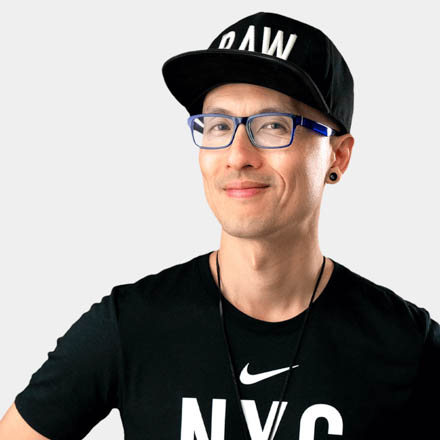
Chris Do
Founder, The Futur™ · March 31, 2026
The Weakness You Hide Is The Brand You Need
There is a stereotype, backed by data, that hangs in the air of American society. The least desirable type of man in America is an Asian man.
It is a brutal assessment. In his 2014 book Dataclysm, based on user data from the dating site OkCupid, co-founder Christian Rudder confirmed it. Asian men received the fewest messages and lowest ratings from women across all racial groups. Chris Do, founder of The Futur, felt the sting of that perception not as a statistic, but as a lived reality.
“Asian men are seen as effeminate, bad drivers, not good lovers, and not very attentive to the other person,” Do states. For years, this societal caricature fed a deep, personal insecurity.
“For a long time, the self-narrative, my own identity was, I wish I wasn't like this,” he admits. “Because all I wanted to do is be invisible my entire life.”
This desire to disappear is the polar opposite of building a personal brand. To build a brand is to be seen, to stand for something, to occupy a distinct space in the minds of others. For Do, the journey to becoming a globally recognized creative entrepreneur was not about finding a new identity. It was about confronting and reversing a lifetime of trying to shed his own.
It was a journey that required him to weaponize his insecurities and turn the very stereotypes meant to diminish him into the foundation of his strength. It's a journey that reveals a fundamental truth about identity and influence. The parts of yourself you are most afraid of are the very source of a brand no one else can replicate.
The Myth of Assimilation
Growing up as a Vietnamese immigrant in San Jose, California, Do’s primary instruction was to fit in. He was born in Vietnam and came to America at age three, not long after the Fall of Saigon in 1975. His parents, unlike some of their siblings, pushed for rapid assimilation. Speaking English at home was not forbidden, and the goal was clear: blend in, quickly.
But blending in is not the same as belonging. The world outside his home was quick to remind him of his otherness. He found himself navigating a narrow set of stereotypes assigned to Vietnamese men in America.
- The Gangster. A tough, fearsome caricature. “Apparently, Vietnamese gangsters are pretty badass,” Do notes wryly. “They'll kill you.”
- The Nail Salon Worker. A trope with a specific history. The industry’s boom is often credited to actress Tippi Hedren, who in 1975 helped a group of Vietnamese refugees learn the trade.
- The Tech Worker. The dominant, model minority myth. “Silicon Valley. You know, you must be a good engineer kind of thing.”
None of these molds fit. “I'm not a gangster. I'm too soft,” Do says. “I don't care about doing nails. And I'm terrible at math.” With his older brother, the “chosen one,” fulfilling the family promise by becoming an engineer, Do was left without a predetermined path.
School was a social minefield. At John Steinbeck Middle School, he was one of only two Asian students. During a class dance, the other kids instinctively tried to pair them. “You two should get together,” they said. The assumption was clear: their race was their most defining characteristic.
Being Vietnamese was not a source of pride, but a magnet for bullies. Following his older brother's advice, Do learned to stand up for himself. He wasn’t big or athletic, but he fought back when he had to, discovering that bullies move on to easier targets. The physical fights were terrifying, but the internal conflict was worse.
The daily anxiety was simpler, more universal. “My biggest concern in school was, I wonder who I'm going to eat lunch with today because I just would not like to eat alone.” This struggle, this feeling of being an outsider, planted a deep seed of self-rejection. The corrosive thought became a mantra: “I wish I wasn’t like this.”
The Power of Pride
A profound shift occurred at his graduation from the prestigious ArtCenter College of Design. It was a place where Do had his own struggles, nearly giving up before pushing through to finish. But on that day, he witnessed something that would recalibrate his entire sense of self.
He saw his Asian classmates, students from Korea, China, and Japan who were not born in America, doing something he never would have dared to do. They were proudly wearing the traditional dress of their home countries.
“I had never seen them before like this,” Do recalls. “Like they were really proud. I would be like I'm not wearing an áo dài. That's not for me. That looks very feminine. I cannot wear that. And I saw them do this. And something changed inside of me.”
The sight triggered a wave of shame. He was ashamed of his own self-hatred, of the years spent wishing away his heritage. For the first time, he saw Asian people exhibiting a level of excellence and pride he had never encountered. He finally understood why.
These students were not a marginalized minority in their home countries. They were part of the dominant culture. To attend an expensive private art school in America, they were likely from the top echelon of their society, the wealthiest one percent. They arrived in the U.S. not as refugees seeking to assimilate, but as members of an elite class, often driving fancier cars and living in nicer places than their American peers.
They carried with them an innate confidence that came from a lifetime of belonging. Their identity was not a source of shame but a symbol of their status. This realization sparked what Do calls a “multi-year-long journey within myself to celebrate and to love myself 100%.”
It was a slow burn. After graduating, Do entered the world of advertising, a predominantly white industry. Working at his own company, Blind, he specialized in commercials and music videos. In the pre-Zoom era, most work was won or lost on conference calls. “They don't see you,” he explains. “You show your work and you pitch and we live in the realm of ideas.”
In this environment, identity was invisible. All that mattered was the quality of the work and the ability to sell it. “You win or die by the phone call.” His company was winning, landing jobs worth hundreds of thousands of dollars. Success in this meritocracy meant his race was irrelevant, allowing him to put the question of identity on the back burner once again.
From Anonymity to Representation
The comfortable anonymity of the conference call shattered in 2014. That was the year Do began creating content for YouTube. Suddenly, he was not just a voice on the phone or a name on a contract. He was a face on a screen. He was an Asian man, a Vietnamese American, teaching design and business to a global audience.
The DMs started pouring in, and with them, an issue he had not considered for years: representation.
“It gave permission to lots of people out there who wanted to pursue the arts and to see what excellence looks like,” Do realized. On YouTube, a platform where anyone with a camera can broadcast, diversity thrived in a way it did not in traditional media. For many aspiring creatives, particularly those of Asian descent, seeing Do operate at the highest level was transformative.
He never set out to be a role model. “I didn't want to carry that burden,” he admits. But the feedback was undeniable. “It was important for people to see people like them doing great.”
This realization ignited a new mission. He decided to turn his personal brand into a direct assault on the stereotypes that had once haunted him. If Asian men were seen as effeminate and passive, he would be the opposite.
“I want to do everything in my power to break down those stereotypes,” he says. “To be a strong masculine fashionable person that understands money and can talk about different things and swim in a lot of different circles so that people can see it's safe to do that.” This deliberate construction of a public persona is a key lesson from those who, as explored in What Successful Personal Brands Do Differently, understand that a brand is a conscious act of communication.
A recent family story perfectly illustrates this reversal. Do’s older son, a philosophy student at Columbia University, started vlogging. During a visit, Do became the subject of one of his son's videos, which promptly went viral on TikTok and Instagram. The comment section exploded with disbelief.
“That is not your dad. Stop.”
“Who this? And are there applications for mother-in-law?”
The most surprising comment was the hashtag: #Zaddy. Do had to look it up. The most aggressive, or thirsty, comments came from a specific demographic: Black women. For Do, this was a profound reversal of the narrative. “Black men are seen as very masculine, as very powerful and desirable,” he notes. “And for me to score points with black women, I'm happily married, but this is kind of cool.”
He jokes with his sons, “You just use me as a thirst trap for your feed.” But the subtext is powerful. The man who once wished he were invisible had become an object of desire, directly subverting the “least desirable” label. More importantly, he had become a hero to his own children. “It's great to be able to meet your heroes,” he says. “It's even better to become one to your own children.”
The Making of a Daywalker
In between the creative professional and the business owner lies a chasm. Most people fall into one camp or the other. You are either the artist, pure in your craft but often struggling financially, or the operator, skilled in making money but creatively unfulfilled. Chris Do lives in the space between.
For 13 years, Do worked with a business coach, the late Keir McLaren. One day, McLaren gave him an assessment that was part insult, part compliment. “Chris, of all my clients, you're not the most creative,” the coach said, and Do knew it was true, admiring many of McLaren’s other world-famous clients. “And you're not the best business person either.”
The punchline followed. “But no one is as good at doing creative and running a business as you.” His coach called him you're the best hybrid.
This hybrid nature is not an accident. It is written into his DNA. His father’s family is composed entirely of Silicon Valley engineers: logical, successful, and analytical. His mother’s side is the opposite: poets, singers, artists, and dreamers who are full of life but often financially insecure. Do is the precise child of these two worlds.
He is also the middle child, literally and figuratively. His older brother is a successful Silicon Valley founder. His younger brother is a freelance visual effects artist. Do is in the middle, embodying both impulses. He has a metaphor for this unique position, borrowed from the Wesley Snipes film Blade.
“He's a vampire, but he was half vampire and half human,” Do explains. “So, they call him Daywalker. He has all the strengths of a vampire and none of the weaknesses.”
Do sees himself as a professional Daywalker. “I have all the strengths and artistic imagination of a designer, creative thinker and the business acumen of a business person and none of the weaknesses between the two.” This philosophy is central to his teachings on building a sustainable creative career, a topic he delves into in Business Advice for Creatives Feeling Lost.
The artist who purely pursues their craft often runs their business into the ground. The businessperson who only chases profit often lacks a creative soul. The Daywalker thrives by integrating both. This is not about balancing two opposing forces but about creating a new, more powerful identity from them.
This required Do to shed a label that had long defined him. For years, his identity was a graphic designer. But he realized the title was a trap. “Being a graphic designer meant you must design graphics,” he says. As he evolved, the title became too small. He was now helping people with business, negotiation, public speaking, and personal branding.
“I still have graphic design tendencies,” he says, “but I've evolved beyond that.” He is a recovering graphic designer, one who broke free from the constraints of his own job title to build something larger.
The Freedom to Become
The final layer of identity is legacy. How do you raise children to have a secure sense of self, free from the generational baggage you carried? Do’s approach to parenting is as unconventional as his approach to business, and it is rooted in the lessons of his own upbringing.
Looking back, he realizes the long hours his immigrant parents worked were an unintentional gift. “It gave me a lot of freedom to learn about who I was going to be in this world,” he reflects, “versus following a blueprint that they wanted to lay out for me.” His father, instead of lecturing, would ask questions, forcing a young Chris to think for himself.
This freedom was most critical when he decided to go to art school. He later learned his father was deeply against it but never said a word. His mother, a small, traditionally quiet woman, stood up to her husband. “You're not allowed to tell him your thoughts,” she declared, shielding her son from the disapproval that might have derailed him. His mother became his hero.
This personal history forms the core of his parenting philosophy today. He has watched his cousins follow the traditional path: staying close to home, becoming doctors, lawyers, and engineers. Yet, many of them, now in their 40s, are poorer than he is and remain preoccupied with their parents’ approval. They never fully broke away to define themselves.
“At one point in your life in your adulthood, I hope that you find the courage to do what you want to do,” Do advises. The people who truly love you will be patient. And even if they are not, you must pursue your own path. This echoes a core tenet of self-determination similar to those discussed in How Words Shape Your Reality.
He applies this principle directly to his two sons. He believes in a philosophy he heard from a yogi: children are born perfect. It's parents who messed them up.
“We're trying to correct the sins of our own past in our own children,” he explains. “We do not have the courage to act. What we want to do is have them act for us.” The parent who never played an instrument but forces their child into piano lessons is a classic example.
Believing his children are already perfect, Do’s goal as a parent is simple: “I'm trying to do as little as possible to harm them.”
The rules in his house are focused on broad principles, not specific paths.
- No physical violence between brothers.
- Respect your parents and others.
- Try not to hurt people.
- The rest is up to you.
He has never checked their homework or looked at a report card. He has actively tried to bribe them to quit school, offering them their college funds with no strings attached. Yet both have excelled, getting themselves into top schools with scholarships, on their own terms.
The result is a relationship built on freedom and mutual respect, not obligation. By giving his children the space to discover who they are, he is breaking the cycle of inherited expectations. He is giving them the gift his parents gave him by accident, but this time, it is on purpose.
The negative consequence of clinging to tradition, he warns, is that people “never fully realize their own identity and their own potential.”
And that, he says, is a shame.
TRANSCRIPT
Enjoyed this? There’s more where it came from.
Get insights on creativity, business, and design from The Futur.
You can unsubscribe anytime. By submitting, you agree to receive communications and to our Privacy Policy.
“I want to do everything I can to break every stereotype.”
— Chris Do
Key Takeaways
Subscribe
Details
- Length
- 28m
- Views
- 32,654
- Topic
- PERSONAL BRANDING